Saturday, August 7, 2010

Newsletter #5: June/July 2010

I hope you all are enjoying the fruits of our labor. We certainly are...almost every night we plan our meals around what's been harvested that day. To be reinvigorated and sustained by the very thing that exhausted you in its creation is somehow incredibly gratifying. Tonight it was a creamy raw zucchini pasta on greens, German Butterball hash, and buttery sweet corn. The mandolined zucchini made a surprisingly full-bodied linguine, the butterballs an almost delicate hash and the corn, well, there's nothing like fresh sweet corn. Yesterday we sampled the butternuts harvested early in July, stuffed with goat's cheese, walnut and carmelized onion. It was quite good, but I'm going to let them cure just a bit longer before passing them (and acorn squash) on to you all.

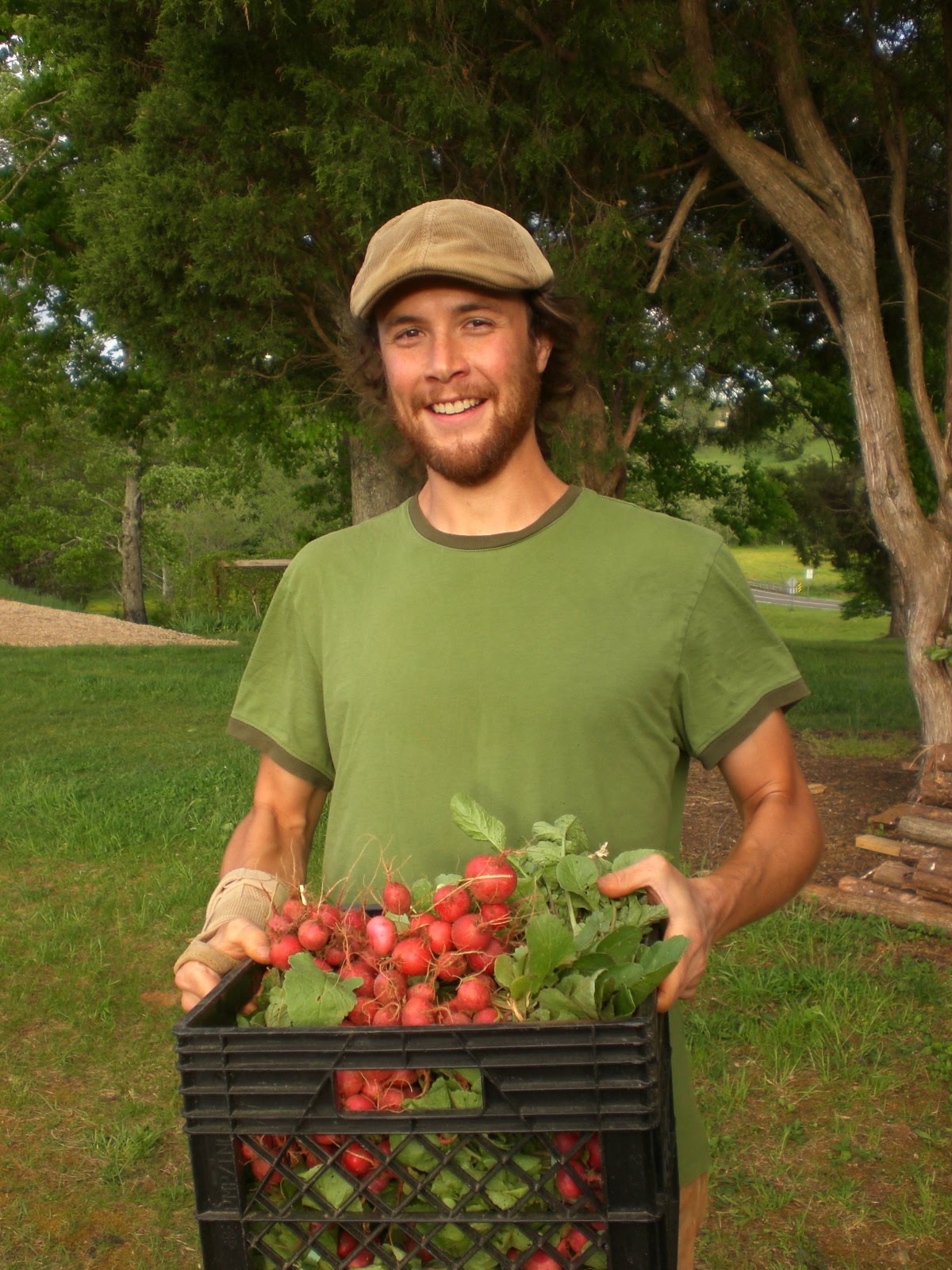
I believe, especially considering the intense heat and June drought, that the summer harvest has been plentiful. Let's just say drip irrigation saved our collective behinds. (I've pictured here items included in a sample "plus" option mid-July box: zucchini and crookneck squash, heirloom and assorted cherry tomatoes, Jericho romaine lettuce, basil, garlic, charleston bell pepper, chili pepper, hungarian hot wax pepper, diva cucumber, along with organic figs and bread sourced locally. June brought two of my favorite bed buddies into the light, garlic and potatoes, and we continue to pull them from our "root cellar" supply. This week's fingerlings ought to please the most discriminating of potato palates. We've been pleased as well with corn production of late - surpassing our early yields - and expect to harvest it through the month of August. The next round of corn is around 10 ft. tall...we can only hope it bears ears to match.

To address the overflow of tomatoes (and lettuce before that) Holly and I have been attending the Krankies Farmer's Market downtown. It's been a gratifying experience and a terrific way to interface with other farmers and the community. We have not been in a couple weeks and it looks as though we won't be returning until possibly fall. Our harvest, while ample, is not so much to justify our presence there for the next couple months...more importantly, we would never risk shortchanging our CSA members by selling an excess of produce. The amount we've brought to market has been carefully calculated so as to avoid overselling. I mention this because some farm CSAs have been accused of doing this to make a few extra bucks, and I wish to be steadfast in our commitment to our shareholders. We've thoroughly enjoyed serving you all (so far) and I hope you all have relished the experience as well. It is truly an amazing feeling to do what you love and have a community at your back, particularly one benefitting directly, and on such a basic level. I can hardly begin to count my thank-you's to you all for helping our family build something so important to us...


Before I get trapped in the sap, I would like to discuss some cultural adjustments I'd like to make for next year's main season. First off, tomatoes. We'd like to provide them June through September, and while we will continue to include them in our shares this season, production has been tapering off. We've provided around 3 Lbs plus cherries every week since mid-June. This will drop off steadily until our late-planted tomatoes produce in earnest. Next year we will better space the plantings to better ensure a plentiful supply through the end of the summer. We will also plant more root crops and succession plant them to extend and (hopefully) increase our harvest of carrots, beets, potatoes, onions and garlic. Most of these have gone directly from the ground to your shareboxes, with smaller amounts going to storage. While I'm sure you all have tasted and appreciated the wonderful richness that is a new potato or onion, it's nice to save a bunch to divy out as time passes. As for beets, I don't necessarily plan to store them (though I do appreciate a good pickled ginger beet), but I would like to have plenty of them come June and July of '11.


I should talk a bit about peppers. First off, we will grow a different variety of main-crop bell pepper next year. The mini-belles you've received are California Wonders - we've wondered why they're not larger. While they're extremely prolific, they've also been strangely small...I believe we received the wrong seed. (It couldn't be our fault.) Thankfully we grew other varieties, and of all the sweets, the Flamingos have greatly outperformed the other varieties. (They're the pale yellow to orange variety in the boxes this week.) As for hot peppers, they're ridiculously productive, as usual. We mixed hungarian wax (pale yellow/orange), jalapeno (smaller green or red) and chilipeno peppers in the boxes this week with a recipe for stuffing them, although there are many ways to prepare them. (Thanks, Nancy, for the sample jar of hot pepper jam - superb.)
Another item you all have received lately are royal burgundy beans. They're to be treated like green beans, though I find the flavor somehow better - maybe it's a trick played by the novelty of them. Your kids will marvel at how they turn from purple to green on the skillet. I'm interested to hear any ideas on preparing them, as we've not had time to experiment much since harvesting. I find garlic and butter go well with most anything!


This morning we harvested watermelons and cantaloupes. It turned out quite a few watermelons were hiding amidst the vines, and we pulled more than expected. We will be passing on some of these modest melons on to you all this week. As for the cantaloupes, let's just say we swallowed the evidence. There will be more ripening in a few weeks or so, hopefully they will resist rot better than those we fished out of the straw this morning.

So a couple of reminders...please try and return all used containers (clamshells, egg cartons, etc.). Please let me know if you need particular herbs for your boxes as I will be happy to provide them. Right now we have genovese, thai and red basil, oregano, rosemary, thyme, dill, mint, lemon balm, sage and chives. Also, we will be drying some batches of tulsi (or holy basil) tea. We've grown quite a bit of it to dry for the tea we drink daily. It has many health benefits, lowering blood pressure and regulating metabolism. I will be happy to provide a sample to anyone requesting it.

Once thank you all for your continued support. Farewell and goodnight.


-K. Isaac Oliver

I leave you with a few photos.


(1) Red Rubin Basil
(2) Cosmos
(3) Clover. One of the many weeds calling our garden home.
(4) Hairy Vetch and a Monarch.

Tuesday, May 18, 2010

Newsletter #4: May 2010


What could a farmer relish more than a string of rainy days, for his vines to swell, his gait to soften and his mind to wander, burying the debris of to-dos in the bliss of blankets and blankness. It is one of the great pleasures of farming to take a respite when Nature suggests it prudent. And rest has never felt so prudent. It is easy to live inside a to-do list, to order your existence around an illusion of tidy efficiency. It is one thing to continually “achieve” completion but quite another to achieve the clarity of knowing nothing is complete and to be O.K. with imperfection. It is enough to know that if you act according to your truth, your every action is complete.


Organic farming challenges any illusion of stasis in life. Change reigns supreme…you ride the wave or get swept out by the tide. Tidy as you may try to be, growth will continue, and growth can hurt, like weeding a hundred-foot row of onions. Weeds are like emotions – kill them off in one fell swoop (with, say, Roundup) and those that survive will regenerate into uber-weeds, peskier than ever. Bury an unwanted emotion or trauma, and the hurt becomes a complex of hurt, increasingly more potent. Somehow hand-weeding is more like “dealing” or “talking it out”. Satisfying? Not necessarily. But it sure is easier to sift and manage the buggers before they spread unchecked. I think you catch my drift.


Besides weeding and psychobabbling, we are still planting. Some crops are best succession planted so the harvest is spread out. Its better having just enough sweet corn to eat (or to sell) for a month than to have a lot all at once, so we are trying to extend our projected harvests of most crops to achieve a sort of drawn-out smorgasbord. In addition to planting, we are considering trellising the many green trails leading every which way. I say considering because there is a long way to go in this department. Tomatoes, Pole Beans and Cucumbers are the first to come to mind…they grow best upright. And if there any hope of winning the battle of the weeds, much straw will be spread.


Early heat and the miracle of drip irrigation, mixed with a bit of sweat on the brow and eventual rain has brought on a flush of growth: sugar snap peas and sugar beets are ripe and sweet fennel is near. Potatoes and garlic are blooming, meaning June harvests a possibility. We began eating cherry tomatoes here and there last week, though we don’t expect to get a proper harvest until it heats up once again. All you CSA members can expect more lettuce for as long as we can fend off the hot, hot weather and broccoli for at least another week (to be followed by cabbages). I hope all you “Plus” members enjoyed the all-natural strawberries provided by Ken Vanhoy of Rail Fence Farm in Kernersville. They were perhaps the finest I’ve tasted. The eggs are compliments of Christina Nazarro of Dragonfly Farm in Pfafftown and Donna Dunlap of Pinnacle. The eggs will be mainstays of the “Plus” program.


I’m sure some of you are wondering why some of the lettuce and broccoli you have been receiving are not like your standard grocery fare. Commercially grown vegetables are typically varieties bred for two characteristics: shelf life and uniformity of appearance. These characteristics come at the expense of taste and character. The lettuces you have been eating are rarely found in markets because they are tender: they wilt and thus quickly shed the illusion of freshness. (Grocery chains are not so much interested in freshness but the appearance of it.) The same goes for broccoli. You all have been receiving (mainly) heirloom, or open-pollinated varieties that have not been hybridized for shelf-life or uniformity. Heirloom broccoli can grow limp quickly, as it is meant to be eaten right out of the garden. Tenderness is a quality in vegetables, like meat, that lends itself to palatability and downright tastiness. Essentially the flavor has been bred out of so many commercial vegetables. Perhaps that is why a child that won't eat salads will change their mind after eating delicate Bibb Buttercrunch or rosy Rouge D’hiver. (Such was the case with a certain CSA member.)


Heirloom plants are those whose characteristics have not been hybridized over time; the seeds have been harvested and handed down over generations, so that when they are planted they are true-to-type. Preserving this tradition helps preserve the diversity of edibles that have colored our culinary and cultural history. Many of the crops we grow at Harmony Ridge are raised from heirloom seed stock. This is why our vegetables have character.


I’ve been pleased with the ease with which the CSA deliveries have been conducted thus far. I would like to thank you all for being as prompt as possible. I have been quite lenient in these first two weeks as far as providing special arrangements for those unable to attend the designated delivery times. However, I cannot guarantee that this will always be the case due to time limitations. If you are unable to attend, please have a friend pick up your basket for you. However, I am a reasonable man, and sometimes a back-up plan is necessary. Any baskets that go unaccounted for I will leave on the front porch of our barn inside a cooler through the weekend. Those that go unclaimed will be donated to my kitchen.


A few other things swimming around my head…recipes are meant to be kept. You may either leave the plastic attached to the basket to be reused or keep it – it’s up to you. Any containers, particularly berry quart boxes or egg cartons may be left inside the previous week’s basket to be reused. The lettuce, as you may know will keep outside the fridge as long as the root ball remains moist. It will keep in the fridge just as well. If the leaves are removed from the plant, they may be preserved per the instructions for storing greens provided by my mom, Wendy. I hope you all have been enjoying her recipes. I would like to thank her for all the hard work she’s put into providing these and for making each week’s delivery less like a plain, old crate of vegetables and more like a neatly wrapped present.


Which leads me to an outpouring of gratitude. There are some family members whose gracious help has egregiously gone unmentioned. My Dad, Kevin, and grandfather, Dale, are the foremost in my mind, as they have given much time and effort not only to help out with the many farm chores but to help shape the man I am. As many of you know, my Dad works full-time in a high-stress position and still manages to be here almost every day putting in his very best. Dale and my grandma Betty helped shape my desire to live an honest life on a farm as I spent many-a-summer on their small farm in Ohio as a youth. At almost 80 years old, Dale has a work ethic like no one I know: when he visits, I can scarce keep up with him. Much of the wood we have stockpiled for next winter was cut by him (and my Dad). I would also like to thank my “Uncle” Phil of PA. He handled our BCS walk-behind tractor like a champ. Thanks also to Mark O’Neil, a good friend of the family from St. Louis. He helped me accomplish in a couple hours what would have taken me an entire day. Thanks also to my wife, Holly, who has provided much needed moral support.


I look forward to seeing you all later this week for our third round of CSA deliveries. As indicated, you all can expect a little more variety this week: beets and sugar snap peas in addition to broccoli, herbs, spring onions and lettuces. To recap our revised weekly delivery schedule:

Thursday, on-farm, between 5 and 7 PM. 3835 Bowens Rd., Tobaccoville, 27050.

Fridays at New Planet Yoga between 10:30 and 11 AM

And then at my parents’ house between 11:45 AM and 1:15 PM. If any of you need to change your usual pick-up locale please let me know. Once again, I ask you to please stick to a weekly routine so your share winds up in the right place. Oh, and don’t forget to bring last week’s empty crate!


I wish you all a salubrious week.


K. Isaac Oliver

of

Harmony Ridge Farms


P.S. To any of you wishing to join our CSA or know of anyone interested, I have begun a waiting list. We may open up more shares for purchase in the near future.

I leave you all with some more pictures from the farm…

Wednesday, May 12, 2010

Ken Vanhoy's Strawberries

Wanted to share this...Ken grows the strawberries all you "plus" members received last week. He's a good man. Growing all-natural strawberries is no easy task. http://www.facebook.com/home.php?#!/notes/krankies-farmers-market/strawberry-fields-forever-ken-vanhoys-quest-for-pesticide-free-strawberries/121138874574077

Monday, April 12, 2010

Ad


Here is an ad I created...just thought I'd share.

Thursday, April 8, 2010

Newsletter #3: April 2010


Spring in the Piedmont: the welcoming buds of maple, then the tumble of cherry blossoms and shock of redbud, a brief taste of the swelter to follow, then back again…the blooms of the dogwood remind you it’s only April.


Where I sit, the creek bottom crackles with sound at daybreak – one song overlapping the next and I reckon our language inferior. The scent of so much growth is sweet as the rot beneath. The balm in the air is heady and uplifting. But how long can such sweetness last?

The organic farmer must be in tune with cycles, the needs of plants according to these cycles and accepting of change, be it for good or otherwise. And this in-tuneness is mostly learned. Sometimes the hard way. He plants a row of cabbage early on – known to be one of the hardiest of crops – a cold night, barely 32, leaves the row mottled and bitten by frost. Cabbage is hardy, yes, but must be hardened (that is, slowly acclimatized to life outside the greenhouse) if it is to thrive. He knew this intellectually, but until he felt the pain of losing something he’d labored for that knowledge was only information. Impatience was not solely responsible for this loss. Muleheadedness had something to do with it. This fall he’ll scatter some cabbage seeds and hope for the best. (This is a hypothetical farmer we are speaking of, by the way.)


There have been a few setbacks. Much of these setbacks may be filed under the heading: “Mistakes made due to bad timing”. (Farming, like music, is all about timing in tune with atmosphere.) Transplanting before a long string of warm, sunny days, tilling ground not quite dry enough and transplanting too near midday are a few examples. Thus far these hard lessons have come outside the greenhouse, where growth has been steady and strong. In an attempt to offset any errors we might make come Spring we started planting early in the greenhouse, following these plantings with a second or third wave through February and March. Ironically, the first wave and every wave thereafter has grown like crazy, and therein has laid the source of most “mistakes made due to bad timing”. There’s been simply too many healthy plants to transfer outside on too few ideal planting days. But we just keep plugging and planting and plenty are thriving. We have been fortunate these 90-some days didn’t send our greens to the dreaded bolt. But there are many good days to come and no “snaps” in sight. So with the accumulated wisdom of a challenging winter and early Spring under my belt, I’ll stride ahead knowing there’s no real need to rush growth, as it happens organically all the time.


As I mull over all that’s been accomplished thus far I can almost marvel at the progress we’ve made since taking off in early fall (with a little help from our friends). First off, most all the infrastructure is in place – the barn lacks only some interior detail work (you can see the finished exterior), the irrigation system is piped in and being stretched from bed to bed and the greenhouse supporting a diversity of plant life. Much of the cover crop has been turned into the soil and amendments added – lime, compost and fertilizer. An ample number of broccoli, lettuce, chard, beet and cabbage (yes, cabbage) plants have acclimated to life outdoors. The alliums (onions, leeks and garlic ) are growing just as well as the weeds that love to accompany them. The radish, snap pea, mustard and arugula seeds we sowed outdoors are growing nicely also. We’re on the brink of seeing the spuds sprout. And it looks like we’ll have some early tomatoes in May if we can coax the bees to get busy.


To our delight, we’ve had great success growing greenhouse lettuces despite the recent heat. Some we planted directly into bags of McEnroe potting soil and others we planted in raised beds atop tables using homemade potting soil. We produced a soil blend in our compost tumbler using aged horse manure, peat moss, vermiculite, greensand and rock phosphate. Once mixed, the soil as transferred to tables topped with chicken wire and synthetic burlap. Our trial batch of lettuce is full grown and tender as can be. Barring any setbacks, we will offer early lettuce to our CSA members by the end of April for pickup at the farm. (I’ll let you all know as soon as they are available.)


We’ve been busy planting edible perennials as well: asparagus, rhubarb, horseradish, blackberry, raspberry and elderberry all went into beds situated near our section of Mill Creek. Fig trees and rosemary grown from cuttings are rooting and vegging out in the greenhouse. There are even little figs! It looks like it will be fall before we can plant many fruit trees – peaches, plums and apples are part of the (very fluid) orchard plan, in addition to some natives such as persimmons and pawpaws. Any advice on what fruits and varieties grow best here is welcome.


In the last few weeks we’ve been lucky to have some volunteer farmhands at the time when we need it most. A couple friends of mine, Kalin Griffin and Michelle Verville, as well as my Mom, Wendy, and wife, Holly, have devoted some of their valuable time to help with some chores around the farm. Michelle is a professional horticulturist and orchard scout from Michigan who is interested in starting a small CSA in her home state and wanted to experience our operation. She provided some valuable organic pest control and greenhousing advice for which I’m most grateful. Thanks Kalin, Holly, Michelle and Mom for all your hard work! We are always open to having an extra hand around…I believe the experience can be educational and fun. Learn practical skills and get a work out in!


Our 2010 CSA is almost full. There are only 3 shares available for purchase. The particulars of our program are covered in the March newsletter posted here: If you are interested in being a part of our charter membership please act fast! Some folks have told us to sign them up: your payment in full reserves your family’s share in our farm. Contact me, Isaac, at harmonyridgefarms@gmail.com or call 336.922.5611 for payment information.


By request, we have decided to offer home delivery as part of the CSA program. Applicants must live within or very near Winston-Salem or within 10 miles of Tobaccoville. Home delivery is $100 for the entire harvest season (May-October) delivered directly to your front door. Delivery will occur on Fridays, as will our share drop-offs.


CSA shares will be available Friday mornings at three locations: (1) Harmony Ridge Farms, 3835 Bowens Rd., Tobaccoville, NC, 27050, (2) New Planet Yoga, 1150 Burke St., Winston-Salem, 27101 (between Burke Street Pizza and Price Davis Florist). Parking is behind the building. And (3) my parents’ front porch (Kevin and Wendy Oliver): 3620 Rosebriar Circle, Winston-Salem, 27106. Specific times for drop-offs and home delivery will soon be determined. If anyone absolutely cannot pickup Fridays, we can talk.


Thanks again to all of you that have supported our farm CSA. Our gratitude goes out to Jeff Holderfield and crew for building an awesome barn as well as Gene Renegar of Triad Turf for helping us set-up an effective irrigation system. Thanks also to Meghan Prior of New Planet Yoga, who has graciously allowed us to use her lot for share drop-offs. And a special thanks to everyone that has provided words of encouragement (and prayers!) Wishing you all a merry April!


Cheers,

K. Isaac Oliver

Manager

Harmony Ridge Farms


My Dad, Kevin, behind our favorite machine: the BCS tiller:


Wednesday, March 3, 2010

March 2010: Newsletter and CSA Info


Yes, strange as it seems the fairer season is only seventeen days off. I almost can't remember the trees in their clothes. Their gnarled, naked bodies are getting old. But soon enough they'll be donning their budded underthings and somehow be reborn. Full-on green-garbed modesty will usher in summer and these wet, white fields will be a distant memory. Interesting how the seasons facilitate forgetfulness, and help us get on with our lives. I appreciate the changes after my time in Washington state, where the seasons are pared down to two: the wet, dark one and the too-short dry one. This winter may have been a long one in here in North Carolina, but we have so much to look forward to.

Not the least of which is home-grown goodness! Our greenhouse is growing more lush by the day. The broccoli is already dwarving the four-inch pots they’ve been transplanted into. We got a little overexcited and planted them a bit early back in January. They’re eagerly awaiting their day outside the plastic.

It looks as though we may have the window we need to plant outside by Sunday or Monday if the ground has a chance to dry out. Onions, leeks, kale, beets and some hardier greens will be planted out, followed by a few peach, plum and fig trees later in the week. Lettuces will go out around late-March under row covers to keep temperatures up a bit at night and deter deer.
I had the chance this past weekend to work some of the beds that will soon be planted, incorporating lime, Harmony fertilizer and compost with our BCS walking tractor. It is a wonderfully versatile contraption, great for intensively working smaller plots. The planting beds are getting nice and fluffy.

The barn is coming along nicely as well. The siding, roof and insulation are installed. In addition, we are now heating our house and greenhouse with wood, as the water stove is up and running. Moreover, the well is irrigating our greenhouse, so I now have time to do other things besides water plants. Like plan for our first CSA…

I suppose you all are wondering what our CSA will be. First off, we will have 20 families (or individuals) sign up for the program. After the initial 20 members confirm their membership a waiting list will be formed. Those topping the list will be given an opportunity to sign up if another member withdraws. Here’s what a subscriber can expect to enjoy:

• 22 weeks of fresh, naturally grown vegetables and herbs grown here, by us for you. The season will run from the week of Mother’s Day (May 9th) to the first week of October.
• The weight of the weekly basket will be between 4-8 Lbs depending on the season.
• The opportunity to help out and learn basic skills on the farm (if so
desired)
• A contribution to the local community and ecosystem by supporting a (near) carbon-neutral, low-waste and chemical-free food production system. The health of our water and soil is of utmost importance to us.
• Close proximity to Winston-Salem. We are 3 miles Northwest of Winston-Salem off Reynolda Rd. Scheduled visits are welcome.
• An annual member farm tour/barbeque.
• The peace of mind of knowing the source of your family’s food.

We have valued the above benefits at $650, to be paid upfront. (This works out to less than $30 per week.) Payment received prior to the harvest season ensures your place as a member and ensures we have the resources we need to provide you with the most vibrant and varied produce possible. Please contact me to see the latest 2010 Harvest Calendar.
Harmony Ridge will also offer a ‘Plus’ program. ‘Plus’ members will receive all of the above listed benefits in addition to the following:

• Locally sourced (really) free-range, vegetarian-fed eggs
• Locally sourced pesticide-free honey
• Locally sourced, seasonally available fruits and berries. All fruits will be as naturally grown as we can find.
• Potted herbs for trying on your greenthumbs at home.

We have priced the “CSA Plus” at $875. The added cost of the “Plus” program figures in the logistics of sourcing, including the time we spend picking fruit and traveling to acquire these goodies.

To assure your place in our CSA please email me at harmonyridgefarms@gmail.com or call 336.922.5611 to arrange payment. You are welcome to see our operation before signing on.
A few more notes on the CSA deliveries. We will set our weekly drop-off locations once we know where our members are located. The two delivery locales will be strategically placed to ensure convenience for each member. Members will also have the option of picking up their produce at the farm in Tobaccoville. Those located outside the immediate Winston-Salem area will, however, be asked to travel to one of our drop-off spots. If you cannot meet on a delivery date, please arrange to have your share collected, otherwise we will donate it.

I’m sure there are some details I left out. Please direct any questions to me, Isaac.

Thank you all for your support. We are tremendously grateful for this opportunity to serve our community.